Description
Along with LaMonte Young, Terry Riley, and Phillip Glass, Steve Reich is one of four early pioneers of American minimalism (Potter 2002). Reich began to develop a view of "Music as a Gradual Process." One of the most natural expressions of this view is Reich's Piano Phase (1967). In his 1968 article on the subject, "Music as a Gradual Process," Reich writes:"I do not mean the process of composition, but rather pieces of music that are, literally, processes.... The distinctive thing about musical processes is that they determine all the note-to-note (sound-to-sound) details and the over all form simultaneously. (Think of a round or infinite canon.)"
Piano 1 Part
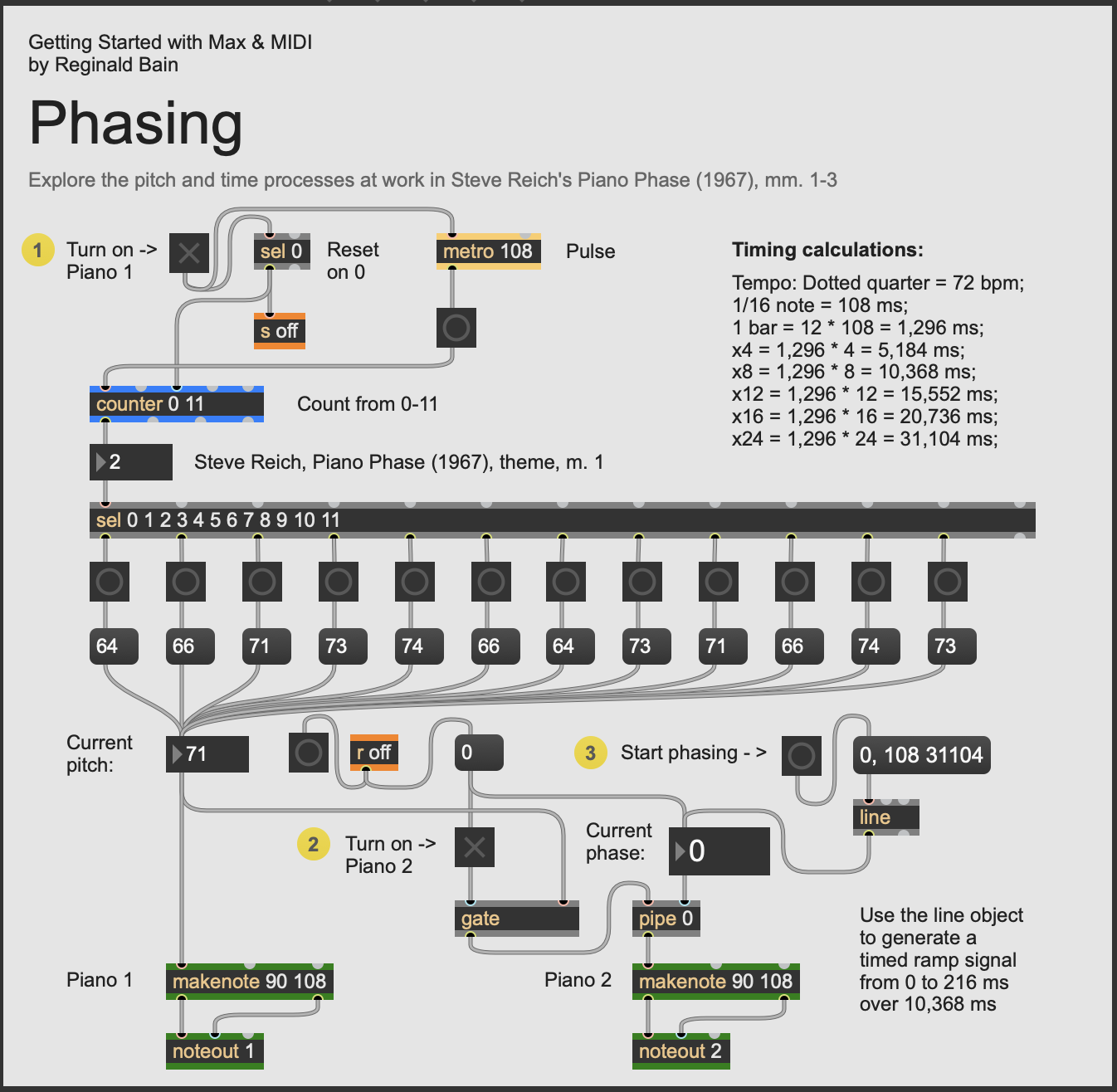
The goal of this patcher is to show the pitch and rhythm process at work in mm. 1-3 of Reich's Piano Phase. The patcher above is a simple extension of the Weighted Random Melody patcher. The theme of Steve Reich's Piano Phase has twelve pitches, so the sel object has twelve arguments (0-11). The theme's rhythm is a constant stream of sixteenth notes at Reich's indicated tempo: dotted quarter = 72 bpm. At this tempo, the duration of each dotted sixteenth note is 213 ms. So we can control the rate of the pulse using a metro object with a time interval argument of 213 ms. The melody's pitches are encoded by the pitch number messages below the sel object. Each pitch is fed into the the usual makenote-noteout pair to create the Piano 1 part.
Piano 2 Part
Piano Phase is essentially a canon with a shifting time interval, so to make the Piano 2 part we simply need to delay the Piano 1 part using a pipe object. To create the canon's shifting time interval, we use a line object and feed it the control message '0, 216 10368', which may be read: go from 0 to 216 ms over 10,368 ms. Since 216 is equal to one sixteenth note, the shifting canonic time interval will start in phase (0) and progress until it is one sixteenth later (216).
The patcher has three textbutton objects which allow the user to interactively control the patcher: 1. On/Off, 2. Turn on Piano 2 , and 3. Start Phasing. Textbutton 1 will start the Piano 1 part. Textbutton 2 turns on Piano 2 with phase shift 0. Textbutton 3 will phase from 0 ms. to 216 ms. over the encoded duration. This may be changed to the various number of repetitions in Reich's score including x4 (10, 368), x8 (20,736), x12 (31,104), etc.
Exploration
In m. 2, the Piano 2 is supposed to fade in. Can you add the necessary code necessary to make that happen?New Objects
- gate - A control flow structure that passes its input to an outlet
- line - Generate a timed ramp of values
- textbutton
– Button with text
Objects
Further Study
- Wikipedia, Minimal music
- Wikipedia, Phase music
- Wikipedia, Piano Phase by Steve Reich
- Wikipedia, Process music
References
Potter, Keith. 2002. Four Musical Minimalists: La
Monte Young, Terry Riley, Steve Reich, Philip Glass.
New York: Cambridge University Press. {GB}
Reich, Steve. 2004. "Music as a Gradual Process." In
Writings on Music, 1965-2000, edited by Paul
Hillier. New York: Oxford University Press, pp. 34-36.
{GB}
Updated: 10/9/25