Description
Up to this point, we have been using the metro
object to provide the pulse for our generative music.
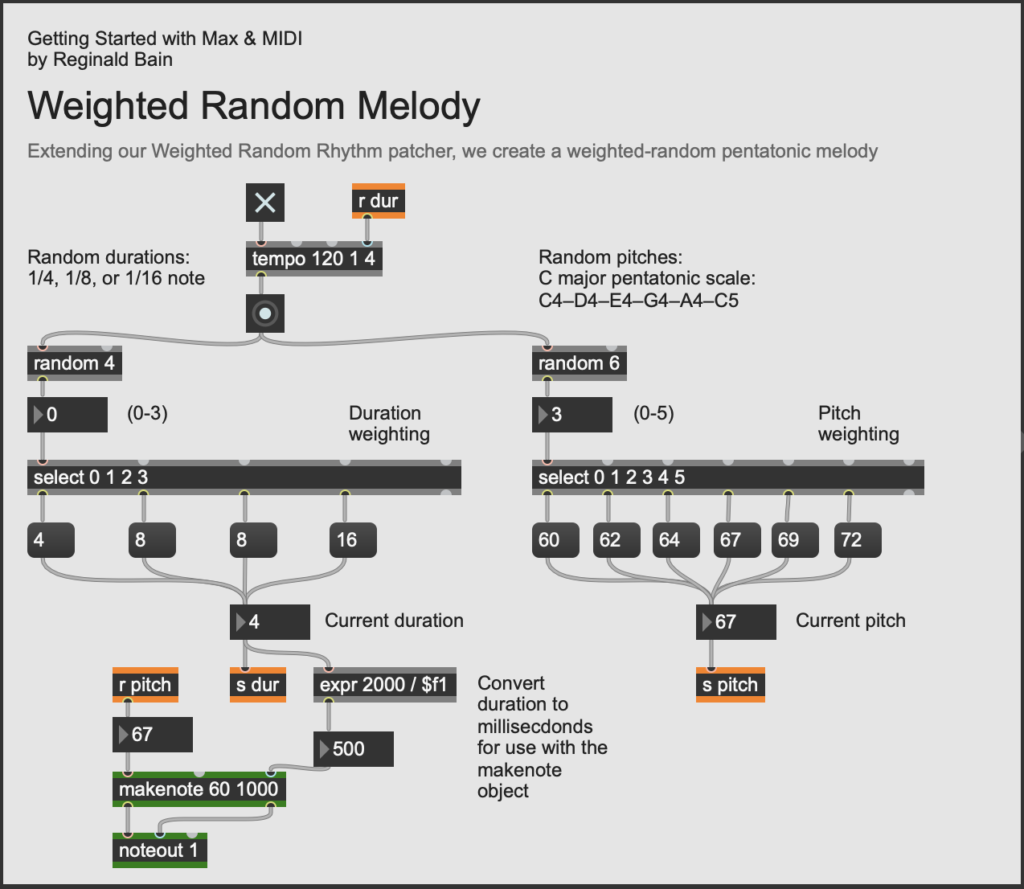
Heretofore, we will use the tempo object which
allows us to express the tempo in beats per minute
rather than milliseconds. What is more, the optional
second and third arguments to tempo allow us to
express a default duration as a fraction. In the
patcher above, the tempo is set to 1/4-note equals 120
beats per minute. Notice how this has opened up a
whole new world of durations to us. Not just 1/4 note,
1/8 note, 1/16 note, 1/32 note, but also 1/1 (whole
note), 1/2 (half note), 1/3 (note), 1/5 note, etc. We
can now easily represent any duration 1/n,
where n is a positive integer. Something the
experimental American Henry Cowell could only dream of
in his book New Musical Resources (1930).
Let's create a random melody. For pitch content,
let's simply select our notes from a major pentatonic
scale on C4: 60, 62, 64, 67, 69, 72. Extending
our Weighted Random Rhythm patchern (07c Weighted
Random Rhythm), we create a weighted-random pentatonic
melody. The patcher is split into two sections. The
left side determines the duration. The right side
determines the pitch. The left side is essentially the
same code block as 07c Weighted Random Rhythm, except
we express durations as fractional values to control
the tempo object. Notice how the current
duration (4, 8, 8, 16) is fed into the second argument
of the tempo object via a send-receive pair. What is
more, the makenote object requires q duration
in milliseconds. This calculation is easy to make. At
120 bpm, a whole note (1/1) is 2000 ms., so we must
simply divide the possible durations 4, 8, and 16 into
2000 ms. using and expr object.
Exploration
As the patcher currently stands, there are 6 equally
weighted pitches. Try weighting one of the pitches to
make the melody more interesting. Of course, you can
also add more pitch messages and corresponding
arguments to the select object to expand the
number of pitches from which you are selecting. You
could even change the scale entirely to enter a new
harmonic realm.
Objects
Further Reading
- Cowell, New Musical Resources (Cowell
2019) {Internet
Archive}
- Dobrian, Randomness in Max, from Computer Music Programming (Dobrian 2019)