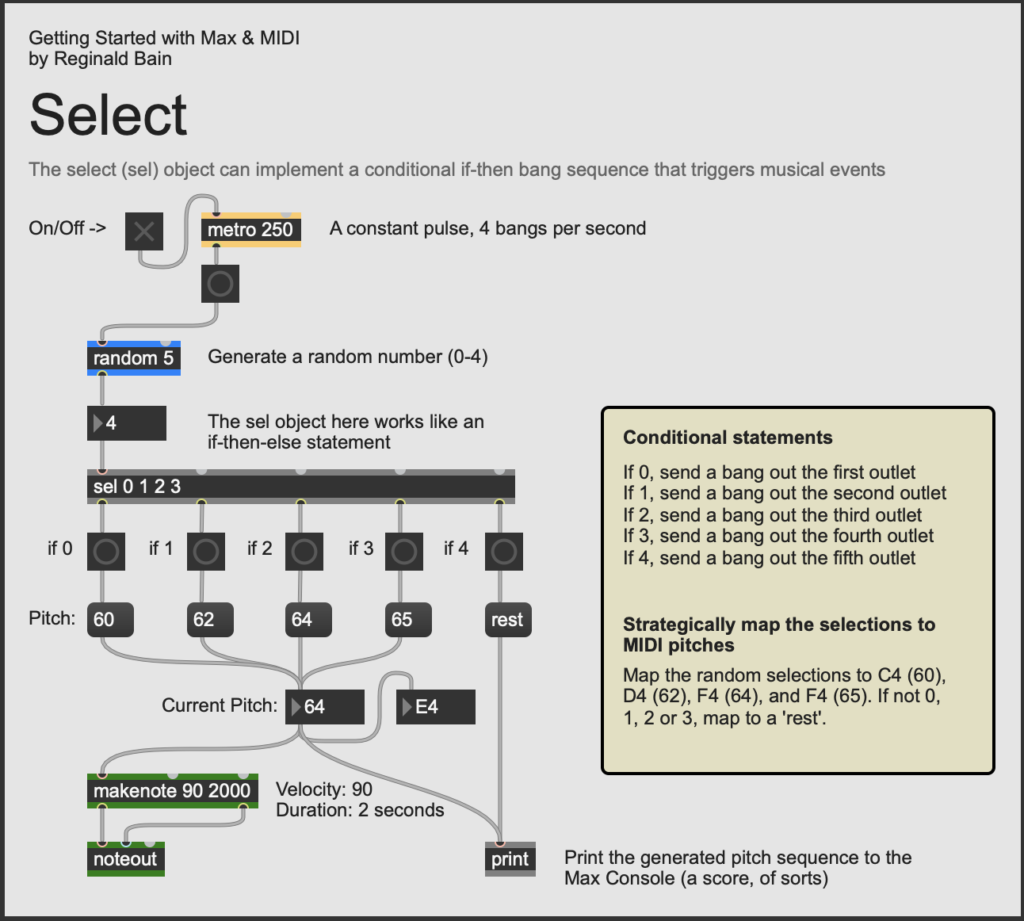
Description
The next three tutorial patchers are related:
- 07a Select
- 07b Send and Receive
- 07c Weighted Random Rhythm
In these patchers, we'll use using Max's select
object to create three very simple examples of generative
music. Generative
music refers to music generated by a system or
process that typically uses random procedures or
algorithms. The term was coined by the electronic
music pioneer Brian
Eno in the late 1970s to describe his use of
systems to create ever-changing music.
There are many other ways to create generative music. Two keep things simple, we will generate a constant pulse and selectively trigger musical events based on that pulse.
For example, we use this general approach in the next
three patchers:
- A metro object generates the
constant pulse by producing bangs at a constant rate
(here the rate is 4 bangs per second).
- The bangs from metro object are sent to a random object to produce a stream of random numbers (here the range is 0-4, inclusive).
- The random numbers are used as control data for a
select object. Be sure to note that
this object may be abbreviated as sel to
save screen real estate.
- In computer programming parlance, we are using sel
here to create a conditional
if-then-else statement whose logic is:
- If the random result is 0, a bang is sent out the 1st outlet of sel.
- If the result is 1, a bang is sent out the 2nd outlet.
- If the result is 2, a bang is sent out the 3rd outlet.
- If the result is 3, a bang is sent out the 4th
outlet.
If the result is 4, a bang is sent out the 5th outlet.
- The 5 buttons below sel were added so the
user can see each button light up as a selection
occurs – another example of self-commenting code.
- The first 4 buttons are mapped to MIDI pitch
numbers. The 5th button is NOT mapped to a MIDI
pitch number to create a rest. This is one
way to create random melodic phrase lengths.
- Each of the 5 outcomes has 20% chance of
occurring, so it is easy to calculate out the
probability of a particular pitch or rest event
occurring.
Although the pitch selections are random, the pitch
mappings has been strategically selected to guarantee
a certain probabilistic musical logic. The four pitch
messages (60, 62, 64, and 65) are the first four notes
of a major
scale on C4. By using a very limited range of
pitches, we guarantee proximity between the
melody’s pitches and thus a sense of smooth voice
leading. By using the lower tetrachord
of a C major scale, we guarantee the melody that the
melody's implied harmony will be freely diatonic.
New Object
- select
(sel) - Output bangs based on input matching
Objects
Updated: 9/23/25